
Sonargraph's Maintainability Level is one of the source-code metrics Understand computes across 17+ languages — browse them in the GUI, export and track them, or script them with the Python API.
Sonargraph's Maintainability Level
| API ID | SonargraphMaintainability |
| Targets | Architectures Project |
| Languages | Any |
| Solution | Project Quality |
| Categories | Coupling |
| Cost | Cached |
| Tags | Dependencies |
The percentage a system is maintainable based on dependencies, with higher values better.
Sonargraph defines their Maintainability Level metric in their blog article A Promising New Metric To Track Maintainability. It is calculated from a dependency graph of system components, with higher values indicating more independent components. Sonargraph recommends aiming for a value higher than 70%, and avoiding values lower than 50%.
Given a dependency graph of system components, the calculation first combines strongly connected components into a single node to get a directed acyclic graph. The graph is then split into levels.
Each node's value is 1 - (influenced_components / components_in_higher_levels).
The idea is to reflect how easily a component can be changed. The more
incoming dependencies, the harder it is to change a given component.
A component in the highest layer is not depended on by anything so it
can be easily changed (value = 1). In contrast, a component
on a lower level is less maintainable based on how much of the system depends
on it.
For a node representing multiple components (a cycle), the value is multiplied
by the number of components in the cycle. Cycles bigger than 5 have an additional
penalty of 5 / size multiplied with the node score.
The final value is the average of each node's value, multiplied by 100 to convert it to a percentage. For example, consider a system with 10 nodes: A-J. Suppose C, D, E, F, G and H form a cycle and A->C, B->I, H->J, and I->J.
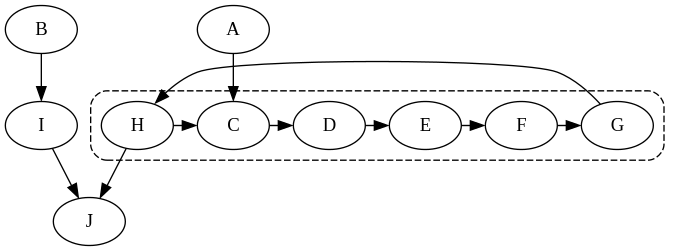
Then:
- A and B on the highest layer each have no incoming dependencies. They each get the full weight of 1.
- I is in the middle layer. There are 2 higher components (A and B) and 1 of
them depends on I. So its weight is
1 - (1/2) = 0.5 - CDEFGH is also in the middle layer so there are 2 higher components (A and B), 1 of which depends on CDEFGH. So the initial weight is 0.5, like I. But there are 6 components in the node, so that value is multiplied by 6, giving 3.0. Finally, the cycle is bigger than 5, so a penalty of 5/6 is applied, giving a final value of 2.5.
- J is on the lowest level, with 9 components higher. All 9 depend on J
so its weight is
1 - (9/9) = 0
So the final value is (1 + 1 + 0.5 + 2.5 + 0) / 10 = 0.5 = 50%.
In this implementation, a component is a file combined with its companion files, such as a C or C++ header and its source file. Files are companions when they have the same name up to the first dot (the last dot for web files) and are in the same folder, or when they are in different folders and one defines most of what the other declares, or when one is a file Qt generates for the other. A component depends on another if any of its files depends on any of the other's files.
This implementation is likely to differ from Sonargraph in the following ways:
- Sonargraph's rules for which files form one component can differ from the companion file rules above.
- Understand's file dependency graph is used, and likely differs from dependencies calculated by Sonargraph.
- The implementation uses the ML2 formula from the blog article, not the final ML4 formula. ML3 adds a sliding minimum for systems with fewer than 100 components. The ML4 formula also considers package cyclicity for some languages.
For a similar metric not influenced by level, see PropagationCost.